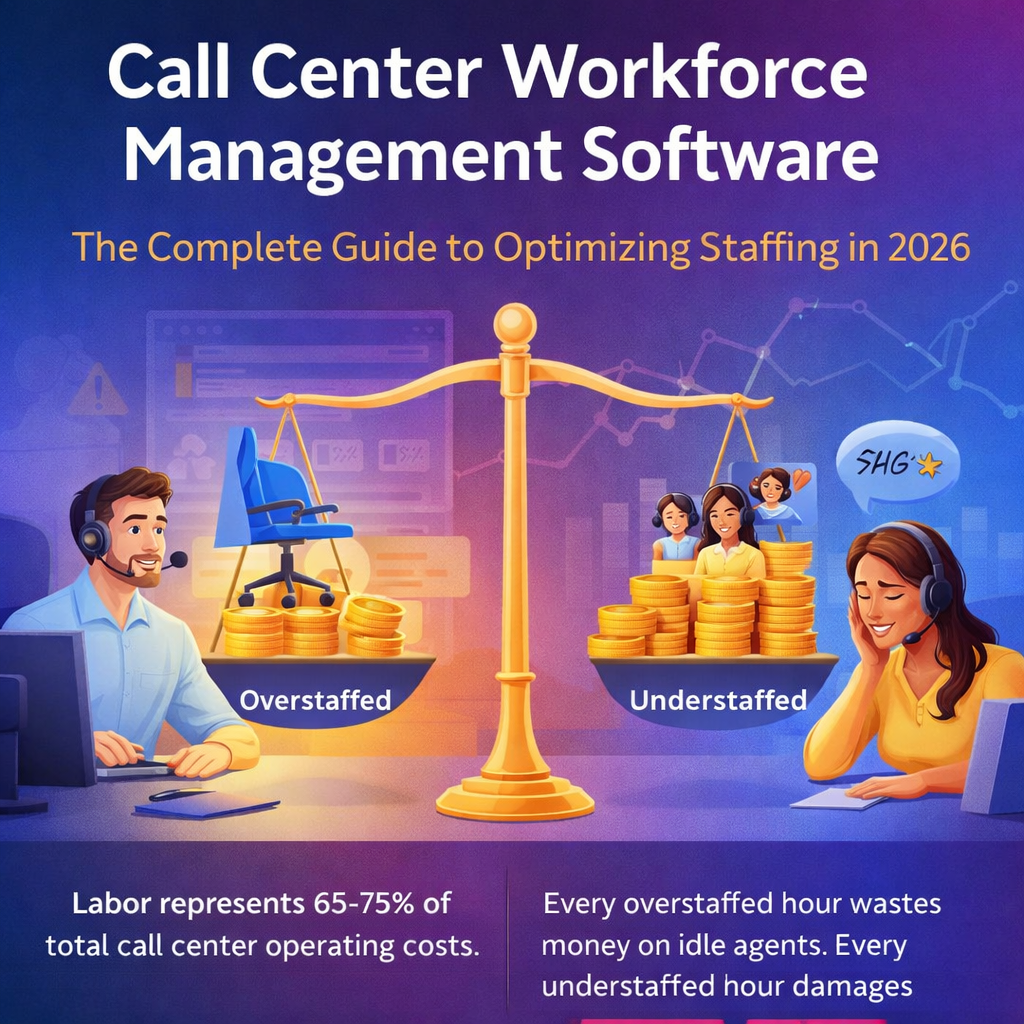
Call Center Workforce Management Software: The Complete Guide to Optimizing Staffing in 2026
Labor represents 65-75% of total call center operating costs. Every overstaffed hour wastes money on idle agents. Every understaffed hour damages customer experience and burns out your team. The difference between optimized scheduling and guesswork can mean hundreds of thousands of dollars annually—even for mid-sized operations.
Call center workforce management software solves this challenge through data-driven forecasting, automated scheduling, and real-time adherence monitoring. Instead of managers spending hours building schedules in spreadsheets, WFM software analyzes historical patterns, predicts future demand, and generates optimized schedules in minutes.
The impact is transformational. Organizations implementing modern WFM achieve 15-25% reduction in labor costs while simultaneously improving service levels. Agents benefit from predictable schedules and fair shift distribution. Managers escape spreadsheet hell to focus on coaching and development.
This comprehensive guide explores everything about call center workforce management in 2026—from forecasting fundamentals to implementation strategies to the leading platforms. Whether you're replacing manual scheduling processes or upgrading legacy WFM systems, you'll discover exactly how to optimize your most expensive resource: your people.
What is Call Center Workforce Management Software?
Call center workforce management software (WFM) is technology that forecasts workload, creates optimized schedules, and monitors real-time adherence to ensure the right number of agents with the right skills are available at the right times.
The WFM Process
Workforce management follows a continuous cycle:
Forecast → Schedule → Monitor → Adjust → Analyze → Improve
    ↑                                              |
    └──────────────────────────────────────────────┘
1. Forecasting: Predict future contact volumes based on historical patterns, known events, and trends.
2. Scheduling: Create agent schedules that match forecasted demand while respecting constraints (skills, preferences, labor rules).
3. Real-Time Monitoring: Track actual volumes and adherence against plan, identifying variances.
4. Intraday Adjustment: Make real-time changes to address unexpected situations.
5. Analysis: Review forecast accuracy and schedule effectiveness.
6. Improvement: Refine models and processes based on learnings.
Core WFM Components
Call center workforce management software includes:
Forecasting Engine:
- Historical data analysis
- Pattern recognition
- Trend projection
- Event modeling
- Multi-channel prediction
Scheduling System:
- Shift generation
- Agent assignment
- Constraint management
- Optimization algorithms
- Schedule publishing
Adherence Monitoring:
- Real-time tracking
- Exception identification
- Variance alerting
- Historical adherence
- Agent accountability
Intraday Management:
- Reforecasting
- Schedule adjustments
- Overtime/VTO management
- Real-time optimization
- Communication tools
Reporting & Analytics:
- Forecast accuracy
- Schedule efficiency
- Adherence metrics
- Performance analysis
- Trend visualization
Why Call Center Scheduling Software Matters
The True Cost of Poor Scheduling
Without proper WFM software call center operations suffer measurably:
Overstaffing Costs:
- Agents paid to wait for calls
- Occupancy drops below 70%
- Cost per contact increases
- Budget overruns
Example: 10 extra agents × 8 hours × $18/hour × 250 days = $360,000 wasted annually
Understaffing Costs:
- Service level collapse
- Increased abandonment
- Customer dissatisfaction
- Agent burnout
- Higher turnover
Example: 5% service level drop → 8% customer churn increase → $500,000+ revenue loss
Manual Scheduling Costs:
- Manager time (10-20 hours/week)
- Errors and conflicts
- Unfair distribution perception
- Limited optimization
- Slow response to changes
Example: Manager @ $75K spending 30% on scheduling = $22,500 in management time
The Business Case for WFM
Call center employee scheduling software delivers quantifiable returns:
| Benefit Area | Typical Improvement | Annual Value (100 agents) |
|---|---|---|
| Labor cost reduction | 15-20% | $450,000 |
| Overtime reduction | 40-60% | $120,000 |
| Shrinkage reduction | 10-15% | $80,000 |
| Manager time savings | 70-80% | $45,000 |
| Turnover reduction | 15-25% | $150,000 |
| Service level improvement | 10-15% | $100,000 |
| Total Annual Benefit | $945,000 |
ROI Calculation:
- WFM Investment (Intell Call): ~$60,000/year
- Annual Benefit: $945,000
- ROI: 1,475%
- Payback: 23 days
Call Center Workforce Management Software Features
Forecasting
Accurate forecasting is the foundation of effective workforce management:
Historical Analysis:
- Volume patterns by interval (15/30/60 min)
- Day-of-week variations
- Seasonal trends
- Growth/decline trajectories
- Handle time patterns
Forecasting Methods:
| Method | Best For | Accuracy |
|---|---|---|
| Time Series | Stable patterns | High |
| Regression | Trend projection | Medium-High |
| Moving Average | Short-term | Medium |
| Machine Learning | Complex patterns | Highest |
| Judgmental | Unique events | Variable |
Event Modeling:
- Marketing campaigns
- Product launches
- Billing cycles
- Holidays and seasons
- Known disruptions
Multi-Channel Forecasting:
- Voice calls
- Chat sessions
- Email volume
- Social media
- Back-office work
Intell Call Forecasting:
- AI-powered predictions
- 95%+ accuracy typical
- Automatic pattern detection
- Event impact modeling
- What-if scenarios
Scheduling
Call center scheduling software automates the complex task of matching staff to demand:
Schedule Generation:
- Automated shift creation
- Skill-based assignment
- Coverage optimization
- Cost minimization
- Fairness algorithms
Constraint Management:
| Constraint Type | Examples |
|---|---|
| Labor Laws | Max hours, required breaks, overtime rules |
| Business Rules | Min coverage, skill requirements, shift lengths |
| Agent Preferences | Preferred days, shift times, time-off requests |
| Contractual | Union rules, seniority, guaranteed hours |
| Availability | Part-time limits, training schedules, meetings |
Optimization Goals:
- Meet service level targets
- Minimize labor costs
- Balance agent workloads
- Honor preferences where possible
- Ensure compliance
Schedule Types:
Fixed Schedules:
- Same shifts each week
- Predictable for agents
- Less optimal coverage
- Common for small teams
Rotating Schedules:
- Shifts rotate weekly/monthly
- Fairer distribution
- Requires adjustment period
- Balanced coverage
Flexible Schedules:
- Variable based on need
- Maximum optimization
- Agent preference input
- Best for large teams
Bid/Preference Schedules:
- Agents bid on shifts
- Seniority/performance priority
- High agent satisfaction
- Requires sufficient staff
Real-Time Adherence
Adherence monitoring ensures schedules translate to reality:
What Adherence Tracks:
| Status | Scheduled | Actual | Adherence |
|---|---|---|---|
| On Call | Working | On call | ✓ In adherence |
| On Call | Working | After-call work | ✓ In adherence |
| On Call | Working | Away | ✗ Out of adherence |
| Break | Break | Break | ✓ In adherence |
| Break | Break | On call | ✗ Out of adherence |
| Lunch | Lunch | Lunch | ✓ In adherence |
Adherence Metrics:
Schedule Adherence:
- Percentage of time in correct state
- Target: >95%
- Measures: Following the plan
Conformance:
- Time working vs. scheduled work time
- Target: >98%
- Measures: Total productive time
Real-Time Alerts:
- Agent out of adherence > X minutes
- Multiple agents out simultaneously
- Coverage dropping below threshold
- Queue building unexpectedly
Intell Call Adherence:
- Real-time dashboard
- Automatic state detection
- Threshold-based alerts
- Historical adherence reports
- Agent accountability tools
Intraday Management
Responding to reality when it differs from forecast:
Reforecasting:
- Update predictions based on actual volumes
- Identify emerging variances
- Project remainder of day
- Trigger action thresholds
Adjustment Options:
When Overstaffed:
| Action | Speed | Impact |
|---|---|---|
| Offer VTO (voluntary time off) | Fast | Immediate cost savings |
| Move to offline work | Fast | Productive utilization |
| Extend breaks | Medium | Minor savings |
| Training/meetings | Planned | Skill development |
| Early release | Fast | Cost savings |
When Understaffed:
| Action | Speed | Impact |
|---|---|---|
| Extend current shifts | Fast | Immediate coverage |
| Call in off-duty agents | Medium | Additional coverage |
| Overtime authorization | Fast | Coverage at premium |
| Reduce after-call work | Fast | More call capacity |
| Adjust service targets | Fast | Managed expectations |
| Cancel meetings/training | Fast | More agents available |
Communication Tools:
- Mass notifications
- Shift offers/requests
- Approval workflows
- Agent self-service
- Mobile access
Agent Self-Service
Empowering agents improves satisfaction and reduces admin burden:
Self-Service Capabilities:
Schedule Access:
- View schedule anywhere
- Mobile app access
- Calendar sync
- Upcoming shift reminders
Time-Off Requests:
- Submit requests online
- View request status
- See available days
- Automatic approval rules
Shift Swapping:
- Find swap partners
- Propose trades
- Manager approval (if required)
- Automatic validation
Preference Setting:
- Preferred shifts
- Unavailable times
- Skill preferences
- Communication preferences
Shift Bidding:
- View available shifts
- Submit bids
- Seniority/performance priority
- Confirmation notifications
Benefits:
- Agent empowerment and satisfaction
- Reduced manager admin time
- Faster request processing
- Fewer scheduling conflicts
- Better work-life balance
Best Call Center Workforce Management Software 2026
After comprehensive evaluation across forecasting accuracy, scheduling power, ease of use, and value, these platforms lead the market:
1. Intell Call WFM — Best Unified Platform
Rating: ★★★★★ (9.9/10) Best For: Complete Workforce Optimization
Intell Call delivers comprehensive workforce management software call center capabilities as part of its unified contact center platform. Unlike standalone WFM tools requiring complex integrations, Intell Call WFM operates on native data—delivering more accurate forecasts and seamless real-time adherence.
Forecasting Capabilities:
- AI-Powered Prediction — Machine learning analyzes patterns
- Multi-Channel Forecasting — Voice, chat, email, back-office
- Event Modeling — Campaign and holiday impact
- Automatic Pattern Detection — Identifies trends without manual input
- What-If Scenarios — Test assumptions before committing
- 95%+ Accuracy — Typical forecast precision
Scheduling Capabilities:
- Automated Generation — Optimized schedules in minutes
- Skills-Based Assignment — Match agents to needs
- Constraint Management — Rules engine for compliance
- Preference Balancing — Fair distribution algorithms
- Multi-Week Planning — Long-range schedule creation
- Scenario Comparison — Evaluate alternatives
Real-Time Management:
- Live Adherence Dashboard — Instant visibility
- Automatic State Detection — Integrates with ACD
- Threshold Alerts — Configurable notifications
- Intraday Reforecast — Updated predictions
- Quick Adjustments — Drag-and-drop changes
- Communication Tools — Agent notifications
Agent Self-Service:
- Mobile App — Schedule access anywhere
- Time-Off Requests — Online submission
- Shift Swap — Agent-initiated trades
- Preference Management — Input availability
- Schedule Notifications — Proactive alerts
Why Intell Call WFM Leads:
- Native integration—no data sync issues
- Single platform—ACD, CRM, WFM unified
- AI-powered—advanced forecasting included
- Accessible—no separate WFM contract
- Scalable—works for 10 or 10,000 agents
Pricing: Included with Intell Call plans starting at $49/user/month Trial: 30 days free, full WFM access
2. NICE IEX — Best Enterprise WFM
Rating: ★★★★☆ (8.7/10) Best For: Large Enterprise Operations
NICE IEX is the industry-standard enterprise workforce management solution.
Key Strengths:
- Industry-leading forecasting
- Comprehensive scheduling
- Advanced simulation
- Extensive integrations
- Proven at massive scale
Considerations: Enterprise pricing; complex implementation Pricing: Custom enterprise (typically $30-50/agent/month additional)
3. Verint Workforce Management — Best Analytics Integration
Rating: ★★★★☆ (8.5/10) Best For: WFO Suite Integration
Verint WFM integrates deeply with quality and performance management.
Key Strengths:
- Strong forecasting engine
- Tight WFO integration
- Good mobile capabilities
- Robust reporting
- Enterprise scalability
Considerations: Premium pricing; best with full Verint suite Pricing: Custom enterprise
4. Calabrio WFM — Best User Experience
Rating: ★★★★☆ (8.3/10) Best For: Ease of Use Priority
Calabrio emphasizes intuitive design and user experience.
Key Strengths:
- Modern, clean interface
- Easy implementation
- Good agent engagement
- Solid core functionality
- Cloud-native architecture
Considerations: Less depth than NICE/Verint for complex needs Pricing: ~$20-35/agent/month
5. Aspect Workforce Management — Best Optimization
Rating: ★★★★☆ (8.2/10) Best For: Advanced Optimization
Aspect (now Alvaria) provides sophisticated optimization algorithms.
Key Strengths:
- Powerful optimization engine
- Advanced scheduling
- Strong intraday tools
- Long market presence
- Flexible deployment
Considerations: Interface less modern; best for complex environments Pricing: Custom
6-10. Additional Strong Options
| Rank | Platform | Score | Best For | Starting Price |
|---|---|---|---|---|
| 6 | Genesys WFM | 8.1/10 | Genesys customers | With platform |
| 7 | Five9 WFM | 7.9/10 | Five9 customers | Add-on |
| 8 | Playvox WFM | 7.8/10 | Quality integration | $15/agent/mo |
| 9 | injixo | 7.6/10 | Cloud-native | €9/agent/mo |
| 10 | Talkdesk WFM | 7.5/10 | Talkdesk customers | Add-on |
Call Center Workforce Management Implementation
Phase 1: Assessment & Planning (Weeks 1-2)
Data Collection:
- Historical contact volumes (12+ months)
- Current schedules and staffing
- Handle time data
- Shrinkage factors
- Service level targets
Requirements Definition:
- Forecasting needs (channels, intervals)
- Scheduling complexity
- Adherence requirements
- Integration points
- User roles and access
Success Metrics:
- Forecast accuracy targets
- Schedule efficiency goals
- Adherence improvement
- Cost reduction objectives
- Service level maintenance
Phase 2: Configuration (Weeks 3-4)
System Setup:
- Create organizational structure
- Define skills and proficiencies
- Configure scheduling rules
- Set up user accounts
- Establish integrations
Historical Import:
- Load contact volume history
- Import agent information
- Configure handle times
- Set shrinkage factors
- Define service goals
Rule Configuration:
- Labor law compliance
- Business rules
- Shift templates
- Break and lunch rules
- Overtime policies
Phase 3: Forecasting & Scheduling (Weeks 5-6)
Forecast Development:
- Generate initial forecasts
- Validate against history
- Adjust for known events
- Test accuracy
- Refine models
Schedule Creation:
- Build first schedules
- Review optimization results
- Adjust constraints
- Validate coverage
- Publish to agents
Training:
- Schedulers on forecasting/scheduling
- Supervisors on intraday management
- Agents on self-service
- Administrators on configuration
Phase 4: Go-Live & Optimization (Weeks 7-8+)
Phased Rollout:
- Pilot with one team
- Monitor closely
- Resolve issues
- Expand to full operation
- Transition from legacy
Ongoing Optimization:
- Track forecast accuracy
- Measure schedule efficiency
- Monitor adherence improvements
- Gather user feedback
- Refine continuously
Workforce Management Best Practices
1. Invest in Forecast Accuracy
Forecasting is the foundation—garbage in, garbage out:
Accuracy Targets:
| Timeframe | Target Accuracy |
|---|---|
| Annual | ±5% |
| Monthly | ±3% |
| Weekly | ±5% |
| Daily | ±5% |
| Interval | ±10% |
Improvement Tactics:
- Document all events affecting volume
- Review and adjust models regularly
- Track and analyze forecast errors
- Incorporate tribal knowledge
- Use multiple forecasting methods
2. Balance Optimization with Humanity
Algorithms optimize numbers; managers must consider people:
Agent Considerations:
- Work-life balance matters
- Consistent schedules when possible
- Fair distribution of undesirable shifts
- Advance notice of schedules
- Reasonable accommodation
Finding Balance:
- Set preference windows before pure optimization
- Allow schedule stability for those who want it
- Rotate weekend/evening shifts fairly
- Provide adequate schedule notice (2+ weeks)
- Enable shift swapping
3. Monitor Adherence Without Micromanaging
Adherence matters, but trust matters too:
Healthy Approach:
- Set reasonable targets (95%, not 100%)
- Focus on patterns, not single instances
- Address chronic issues, not occasional
- Explain the "why" behind adherence
- Recognize good adherence
Avoid:
- Second-by-second tracking
- Punitive responses to minor variances
- Ignoring systemic issues
- Unrealistic expectations
- Creating anxiety
4. Enable Agent Empowerment
Self-service drives satisfaction and efficiency:
Empower Agents To:
- View schedules easily
- Request time off online
- Swap shifts with peers
- Set availability preferences
- Receive proactive notifications
Benefits:
- Higher agent satisfaction
- Reduced manager admin
- Faster request processing
- Better schedule fit
- Lower turnover
5. Close the Loop with Analysis
Continuous improvement requires measurement:
Regular Reviews:
| Cadence | Review Focus |
|---|---|
| Daily | Forecast accuracy, adherence |
| Weekly | Schedule efficiency, variances |
| Monthly | Trends, shrinkage, performance |
| Quarterly | Process improvements, goals |
Key Questions:
- Where did forecasts miss? Why?
- Were schedules efficient?
- What drove adherence issues?
- How can we improve?
Call Center Workforce Management Metrics
Forecasting Metrics
| Metric | Definition | Target |
|---|---|---|
| Forecast Accuracy | Actual vs. predicted volume | ±5% daily |
| Mean Absolute Error | Average variance magnitude | Minimize |
| Bias | Consistent over/under forecasting | Near zero |
| Interval Accuracy | 30-min period precision | ±10% |
Scheduling Metrics
| Metric | Definition | Target |
|---|---|---|
| Coverage | Scheduled vs. required FTEs | 100% |
| Schedule Efficiency | Productive hours / paid hours | >85% |
| Overtime % | Overtime hours / total hours | <5% |
| Preference Fulfillment | Preferences honored | >70% |
Adherence Metrics
| Metric | Definition | Target |
|---|---|---|
| Schedule Adherence | Time in scheduled state | >95% |
| Conformance | Work time vs. scheduled | >98% |
| Unplanned Shrinkage | Unexpected unavailability | <5% |
| Planned Shrinkage | Meetings, training, PTO | Track |
Operational Metrics
| Metric | Definition | Target |
|---|---|---|
| Service Level | Calls answered in target | 80/20 |
| Occupancy | On-call time / available time | 80-85% |
| Utilization | Productive / paid hours | >88% |
| Cost Per Contact | Total cost / contacts | Minimize |
Workforce Management for Different Scenarios
Multi-Site Operations
Challenges:
- Different time zones
- Varied labor rules
- Site-specific patterns
- Cross-site routing
WFM Approach:
- Unified forecasting with site splits
- Site-specific scheduling rules
- Virtual pooling optimization
- Centralized monitoring
Multi-Channel Environment
Challenges:
- Different handle times by channel
- Skill requirements vary
- Blending optimization
- Channel switching
WFM Approach:
- Channel-specific forecasting
- Multi-skill scheduling
- Blended workload optimization
- Real-time channel management
Remote/Hybrid Workforce
Challenges:
- Visibility into remote work
- Home environment factors
- Communication gaps
- Adherence monitoring
WFM Approach:
- Cloud-based WFM access
- Mobile self-service
- Virtual adherence monitoring
- Enhanced communication tools
Seasonal/Variable Volume
Challenges:
- Dramatic volume swings
- Hiring/ramping needs
- Cost during low periods
- Service during peaks
WFM Approach:
- Long-range forecasting
- Flexible scheduling strategies
- Part-time/gig workforce
- Overtime/VTO planning
Frequently Asked Questions
What is call center workforce management software?
Call center workforce management software (WFM) forecasts contact volumes, creates optimized agent schedules, monitors real-time adherence, and enables intraday adjustments. It ensures the right number of skilled agents are available at the right times to meet service goals.
What is call center scheduling software?
Call center scheduling software automates the creation of agent work schedules based on forecasted demand, agent skills, availability, preferences, and business rules. It replaces manual spreadsheet scheduling with optimized, algorithm-driven schedules.
How does WFM software improve call center performance?
WFM software improves performance by: matching staffing to demand (reducing over/understaffing), optimizing schedules (maximizing efficiency), monitoring adherence (ensuring plan execution), and enabling rapid adjustments (responding to variances).
What is schedule adherence in call center?
Schedule adherence measures whether agents are in the correct state (on call, break, lunch) at the scheduled time. Target adherence is typically >95%. High adherence ensures forecasted coverage translates to actual coverage.
How accurate should call center forecasts be?
Daily forecasts should be within ±5% of actual volume. Interval (30-minute) forecasts should be within ±10%. Higher accuracy enables better scheduling and more efficient staffing.
What is the ROI of workforce management software?
WFM software typically delivers 15-25% reduction in labor costs through better scheduling, plus improved service levels and agent satisfaction. ROI commonly exceeds 1,000% with payback in under 30 days.
Transform Your Workforce Management
Every poorly optimized schedule costs money—overstaffing wastes labor dollars while understaffing damages customer experience and burns out agents. The contact centers winning in 2026 leverage WFM technology that matches staffing precisely to demand while empowering agents with flexibility and fairness.
Intell Call WFM delivers complete workforce management within a unified platform:
✓ AI Forecasting — 95%+ accuracy predictions
✓ Automated Scheduling — Optimized schedules in minutes
✓ Real-Time Adherence — Live monitoring dashboard
✓ Intraday Management — Rapid adjustment tools
✓ Agent Self-Service — Mobile schedule access
✓ Time-Off Management — Online request workflow
✓ Shift Swapping — Agent-initiated trades
✓ Performance Analytics — WFM reporting suite
✓ Multi-Channel Support — Voice, chat, email
✓ 30-Day Free Trial — Full WFM access
Start Your Free Trial → www.intellcall.com/workforce-management