Introduction
If you have ever called a business and heard "Press 1 for Sales, Press 2 for Support" — that was an IVR system at work.
Most businesses set it up once and forget about it. But the truth is, a well-configured IVR system is one of the most powerful tools a call center can have. It reduces agent workload, cuts wait times, and makes your business sound professional from the very first ring.
In this guide, we break down exactly what an IVR system is, how it works, what it costs, and which solution makes the most sense for your business in 2026 — whether you run a 5-person team or a 500-seat call center.
What Is an IVR System?
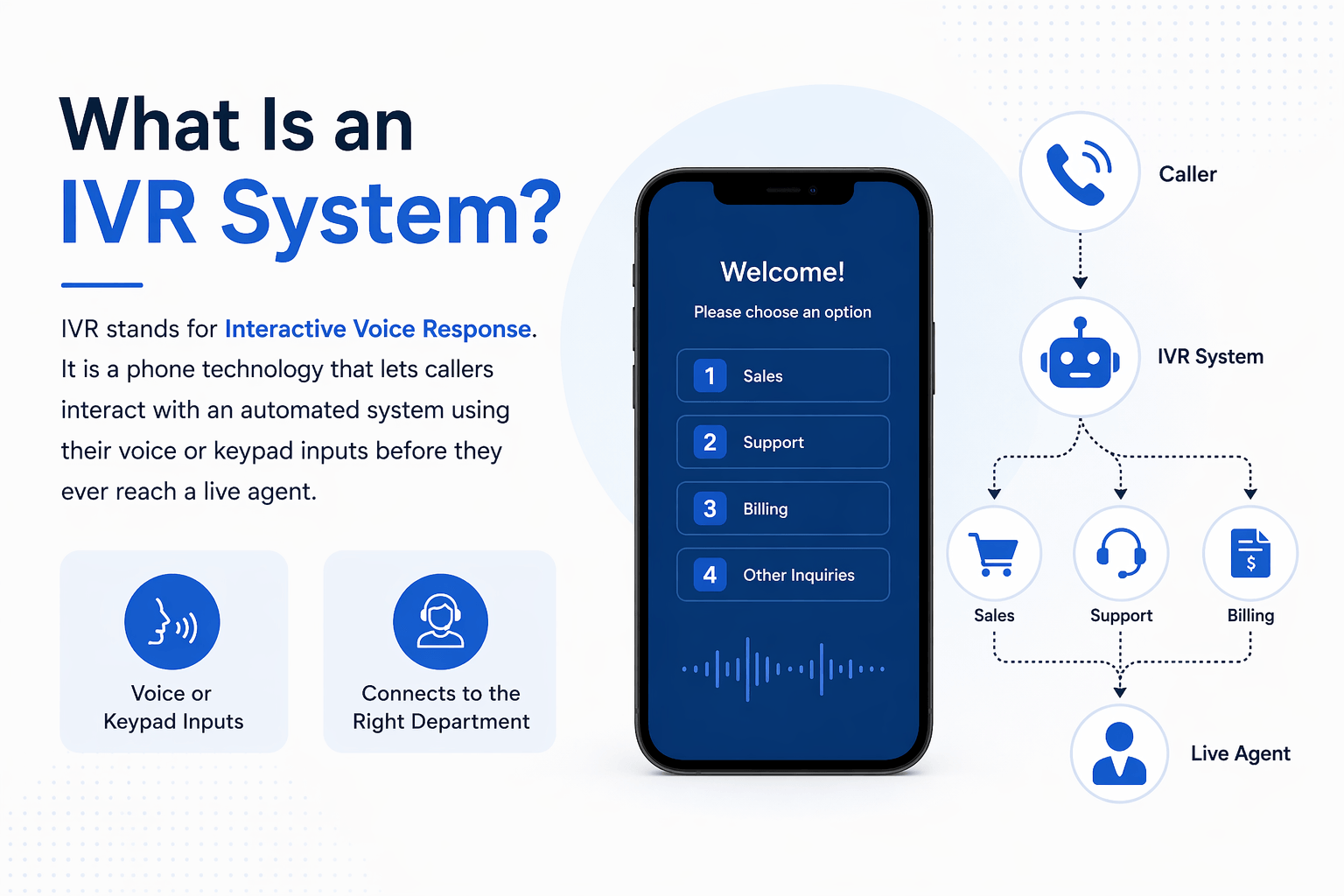
IVR stands for Interactive Voice Response. It is a phone technology that lets callers interact with an automated system using their voice or keypad inputs before they ever reach a live agent.
Think of it as your virtual receptionist — available 24 hours a day, 7 days a week, never on lunch break, never having a bad day.
When a customer calls your business, the IVR greets them, presents options, collects information, and then routes the call to the right department or agent. In more advanced setups, it can even resolve the issue entirely without any human involvement.
The term IVRS system simply refers to Interactive Voice Response System — same thing, just with the word "system" included.
How Does an IVR System Work?
Here is what happens behind the scenes every time a customer calls a business with IVR enabled:
The customer dials the number. The IVR plays a pre-recorded greeting. The caller selects an option — either by pressing a key or speaking out loud. The system processes the input and routes the call accordingly. If it is a simple request like checking a balance or confirming an appointment, the IVR handles it automatically. If the caller needs a human, the system transfers them to the right agent with context already attached.
Modern IVR systems, including AI IVR systems, can understand natural speech. Instead of pressing 2, a customer can say "I want to check my order status" and the system understands and responds appropriately. This is where traditional IVR is evolving into what many now call AI voice agents.
IVR System vs AI Voice Agent: What Is the Difference?
This is one of the most searched questions right now, and for good reason.
A traditional IVR system works on fixed menus. You press 1, you get option A. You press 2, you get option B. It is predictable and reliable, but it can feel rigid to callers.
An AI IVR system — or AI voice agent — goes further. It uses natural language processing to understand what callers are actually saying, even if they do not follow a script. It can handle complex conversations, learn from interactions, and personalize responses based on customer history pulled from your CRM.
For most small businesses and call centers in 2026, a modern hosted IVR system with AI capabilities gives you the best of both worlds — the structure of traditional IVR with the flexibility of conversational AI.
Types of IVR Systems
Not all IVR systems are the same. Here are the main types you will come across:
Inbound IVR System This handles incoming calls. It is the most common type — greeting callers, collecting information, and routing them correctly. Used heavily in customer service, healthcare, banking, and retail.
Outbound IVR System This proactively calls customers on your behalf. Common use cases include appointment reminders, payment notifications, survey follow-ups, and emergency alerts. An outbound IVR system can contact hundreds of customers simultaneously without any agent involvement.
Cloud IVR System Instead of installing hardware on-site, a cloud IVR system is hosted on remote servers and accessed via the internet. This is the preferred choice for most businesses in 2026 because it is faster to set up, easier to scale, and far more affordable than traditional on-premise systems.
Hosted IVR System Similar to cloud IVR, a hosted IVR system is managed by a third-party provider. You get all the functionality without the IT headache. Your provider handles uptime, updates, and security.
Multi-Level IVR System This type allows for layered menus. A caller might press 1 for billing, then be presented with another set of options — press 1 for invoice questions, press 2 for payment issues. Multi-level IVR is useful for businesses with multiple departments or services.
IVR Payment System A specialized IVR used specifically for processing payments over the phone. A secure IVR payment system lets customers pay bills, make purchases, or renew subscriptions without speaking to an agent — which also reduces PCI compliance risk.
IVR System for Call Centers
For call centers specifically, an IVR system is not a luxury — it is a core piece of infrastructure.
Here is what a properly configured IVR system for call centers actually does:
It filters calls before they reach agents. Callers who just need basic information never hit the queue. This alone can reduce your inbound call volume by 30 to 40 percent.
It collects caller data upfront. By the time the call reaches an agent, the IVR has already captured the customer's name, account number, reason for calling, and preferred language. Agents can skip the awkward verification stage and jump straight into solving the problem.
It distributes calls intelligently. Working alongside your ACD system, the IVR ensures each caller reaches the agent best qualified to help them — whether that is based on language, skill set, or issue type.
It keeps your call center running after hours. Even when your agents go home, the IVR can handle basic inquiries, take messages, and schedule callbacks for the next business day.
For any call center looking to improve first-call resolution rates and reduce average handle time, a reliable IVR system is one of the highest-ROI investments available.
IVR System for Small Business
Many small business owners assume IVR is only for large enterprises. That is a misconception worth clearing up.
A cloud-based IVR system for small business is affordable, quick to deploy, and makes even a three-person team sound like a professional operation. When a potential customer calls and hears a polished, organized greeting — rather than a chaotic handoff — it builds trust immediately.
For a small business, the key benefits are straightforward. You handle more calls without hiring more staff. You stop missing calls outside of business hours. You route calls correctly the first time instead of playing phone tag. You free up your team to focus on work that actually requires a human.
A simple IVR system for a small business can be set up in under an hour using a hosted or cloud solution, and most providers charge a fraction of what traditional systems used to cost.
IVR System Cost: What to Expect in 2026
IVR system cost varies significantly depending on the type of deployment, the number of channels, and the features you need.
On-premise IVR systems — the old way — required expensive hardware, dedicated IT staff, and long setup timelines. Costs could run into tens of thousands of dollars upfront.
Cloud and hosted IVR systems have changed the equation entirely. Today, most businesses pay a monthly subscription fee based on usage or number of seats. Entry-level plans for small businesses typically start around $30 to $80 per month. Mid-tier solutions for growing call centers generally range from $100 to $400 per month. Enterprise-grade IVR with advanced AI and CRM integration can go higher, but even those are a fraction of what on-premise used to cost.
The best way to evaluate IVR system cost is not just the monthly fee — it is the cost per resolved call. A good IVR system that handles 35 percent of your inbound volume without agent involvement can pay for itself within the first month.
Best IVR Systems in 2026: What to Look For
When comparing the best IVR systems, these are the features that separate good from great:
Ease of setup. You should not need a developer to configure your call flows. The best IVR systems offer a drag-and-drop builder that lets non-technical staff build and update menus in minutes.
CRM integration. The real power of IVR comes when it connects to your customer data. An IVR that pulls up a caller's account history before routing them to an agent makes every interaction faster and more personal. Challenges in integrating IVR systems with CRM software are common, so look for a provider that offers native integrations rather than complex workarounds.
AI and natural language processing. The gap between traditional IVR and AI voice agents is closing fast. Choosing a platform that already has AI capabilities built in future-proofs your investment.
Outbound calling. Many businesses only think about inbound, but outbound IVR can dramatically improve collections, appointment adherence, and customer satisfaction scores.
Analytics and reporting. You need to see where callers drop off, which options get selected most, and how your IVR performance affects overall call center metrics. Strong reporting is non-negotiable.
Uptime and reliability. A global IVR monitoring system or built-in redundancy ensures your calls never go unanswered due to system downtime.
Security for payments. If you process payments by phone, look specifically for a secure IVR payment system that is PCI DSS compliant.
IVR in Specific Industries
Pharmacy IVR System Pharmacy IVR systems are heavily used for prescription refill requests. Customers call in, navigate the IVR, enter their prescription number, and the system places the refill order automatically. When comparing pharmacy software with integrated IVR refill request systems, look for HIPAA compliance and direct integration with dispensing software.
Bank IVR System A bank IVR system handles account balance inquiries, transaction history, fund transfers, and fraud alerts — all without requiring a live agent. Banks were early adopters of IVR for good reason: the technology offloads enormous call volume at minimal cost.
Medicare and Healthcare IVR The Medicare IVR system is used by millions of callers to check eligibility, confirm coverage, and get basic benefit information. Healthcare organizations generally use inbound IVR systems to handle appointment scheduling, lab result notifications, and patient intake.
Clinical Trials (IVRS) IVRS systems for clinical trials are a specialized application. In this context, IVRS — Interactive Voice Response System — is used to randomize patients, manage drug supply, and collect data during pharmaceutical studies. Enterprise IVR migration testing and load testing IVR systems are common requirements in this space to ensure data integrity at scale.
IVR System Testing and Load Testing
Before going live, especially for enterprise deployments, IVR system testing is essential.
Load testing IVR systems means simulating high volumes of simultaneous calls to see how the system performs under peak traffic conditions. Tools like Empirix (now part of Cyara) and Hammer are commonly used for this purpose. Testelium is another platform mentioned in this space for reliability testing.
For enterprise IVR migration testing, the goal is to validate that all call flows, integrations, and routing rules work correctly after moving from one platform to another — without disrupting live operations.
The best solutions for load testing IVR systems reliability under peak traffic typically involve automated scripting that mimics real caller behavior across hundreds or thousands of concurrent calls.
IVR System Vendors: How to Choose
The IVR system vendors market is crowded. Here is a practical way to narrow it down.
Start with your call volume. If you handle fewer than 500 calls per day, a cloud-hosted solution with a monthly subscription is almost certainly the right answer. No hardware, no IT overhead, no long-term contracts.
Consider your CRM. If you are already using a CRM, your IVR system should integrate with it natively. An IVR that cannot pass caller data to your agents defeats half its purpose.
Think about growth. The best IVR system vendors offer platforms that scale with you — adding channels, languages, and AI capabilities as your needs evolve.
Ask about support. When your IVR goes down at 2am, you need someone to answer the phone. Vendor support quality is often the deciding factor that does not show up in feature comparisons.
Why Intell Call Is Built for This
Intell Call was designed specifically for businesses that need reliable, integrated communication infrastructure without the enterprise price tag.
The platform brings together VoIP, IVR, CRM, and call center tools under one roof. That means your IVR system does not just answer calls — it connects directly to your customer records, logs every interaction, and feeds your agents the context they need before they say hello.
For call centers, the combination of a smart IVR system with Intell Call's live panel and advanced reporting gives supervisors full visibility into how calls are being handled from the moment a customer dials in.
For small businesses, the hosted setup means you can be live in a single afternoon — no hardware, no IT team, no complicated configuration.
Frequently Asked Questions
What is an IVR system? An IVR (Interactive Voice Response) system is a phone technology that greets callers, presents menu options, and routes them to the right destination — either an automated response or a live agent — based on their input.
What is the difference between IVR and IVRS? They refer to the same thing. IVRS simply means Interactive Voice Response System, with "system" added explicitly.
How much does an IVR system cost? Cloud-based IVR systems for small businesses start around $30 to $80 per month. Enterprise solutions with AI and deep CRM integration vary widely. On-premise systems carry significantly higher upfront costs.
What is an outbound IVR system? An outbound IVR system makes automated calls to customers — for reminders, notifications, surveys, or collections — without requiring live agent involvement.
Can a small business afford an IVR system? Yes. Modern cloud IVR systems are designed for businesses of all sizes. Many small business plans are available at low monthly rates with no hardware required.
What is an AI IVR system? An AI IVR system uses natural language processing to understand what callers say, rather than requiring them to press specific keys. It can hold more natural conversations and handle more complex requests than traditional menu-based IVR.
Is IVR secure for payments? A secure IVR payment system can be PCI DSS compliant, meaning it handles cardholder data in a way that meets industry security standards. Always verify compliance before processing payments via IVR.
Conclusion
An IVR system is one of those tools that looks simple from the outside but does heavy lifting behind the scenes. When it is set up well, callers feel guided and respected. Agents spend less time on routine calls. Supervisors see cleaner data. And businesses handle more volume without burning out their teams.
In 2026, the choice is not really whether to use an IVR — it is which type fits your operation best. Cloud and hosted IVR systems have made the technology accessible to businesses of every size, and AI is making it smarter every month.
If you are evaluating options, start with what you need today and choose a platform that can grow with you. Intell Call is built to do exactly that.