# Inbound vs Outbound Call Center: Which Model Fits Your Business?
If you've ever tried to figure out what type of call center your business actually needs, you're not alone. Most people get confused between inbound and outbound call center services — and honestly, it makes sense. The two models look similar on the surface but serve completely different purposes.
In this guide, we're going to break it all down in plain language. No fluff, no jargon overload. By the time you finish reading, you'll know exactly which model fits your business, and what to look for when choosing call center outbound services or inbound support.
## What Is an Inbound Call Center?
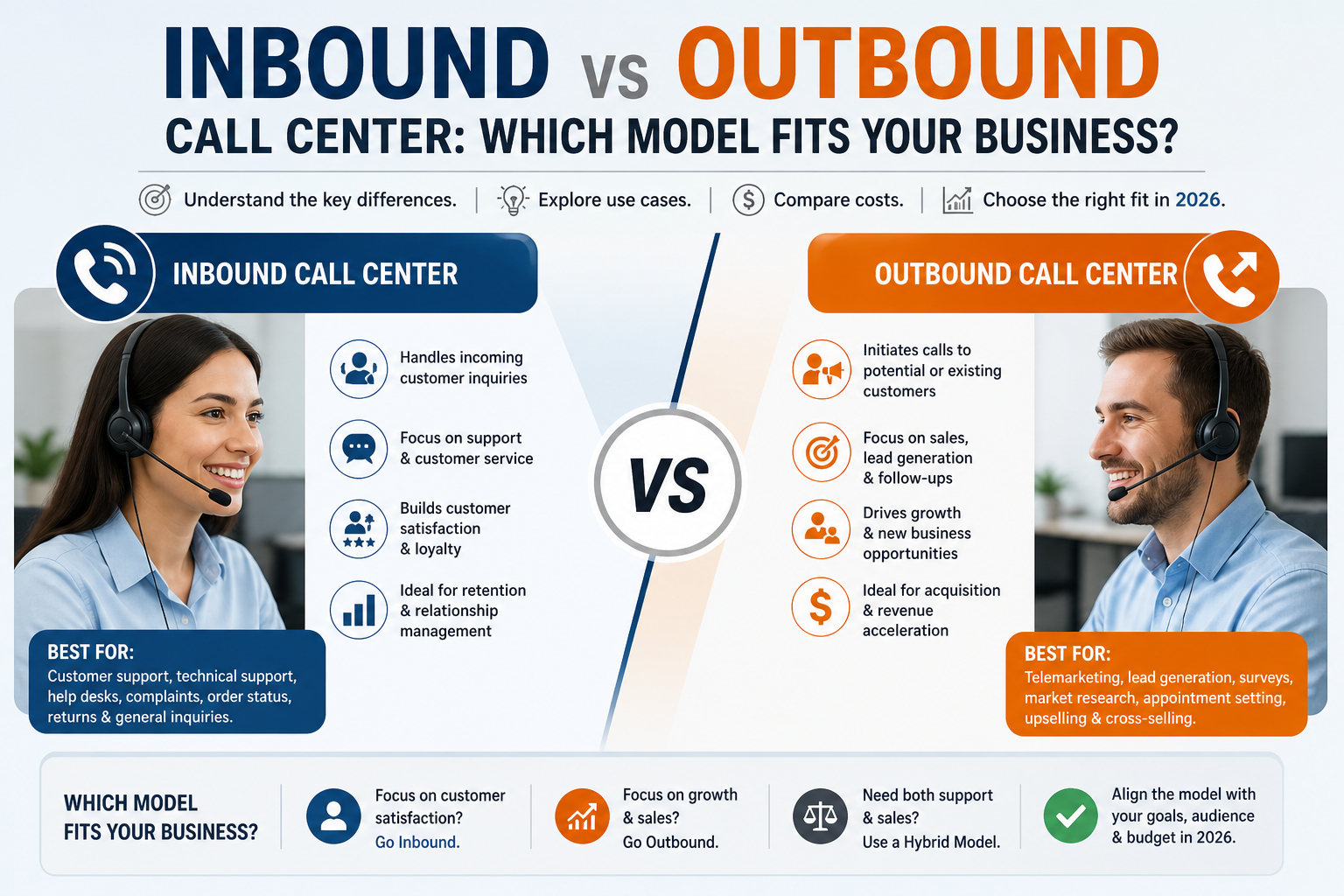
An inbound call center is one where agents receive calls from customers. The customer initiates the contact. Think about when you call your internet provider because your connection is down — that's an inbound call center picking up.
Common use cases for inbound call centers include:
- Customer support and help desks
- Technical support lines
- Order tracking and returns
The whole point of an inbound setup is to be available when your customers need you. The quality of service here heavily depends on things like wait times, first call resolution (how often the issue gets fixed in one call), and agent knowledge.
If your business is customer-heavy and people regularly reach out with questions or problems, you almost certainly need some form of inbound call center setup.
## What Is an Outbound Call Center?
An outbound call center is the opposite — your agents are the ones making the calls. The business initiates contact with prospects or existing customers.
Common use cases for outbound call center services include:
- B2B and B2C sales calls
- Lead generation and prospecting
- Follow-up calls after a purchase or inquiry
- Market research and surveys
- Telemarketing campaigns
Outbound call centers are essentially proactive. You're going to the customer rather than waiting for them to come to you. This is why outbound sales call center operations are so popular in industries like real estate, insurance, and software sales — you need to reach people before your competitors do.
A good outbound call center uses tools like predictive dialers, call scripts, and CRM integrations to make agents more efficient and help them have better conversations. You can read more about how Intellcall's predictive dialer works here: https://intellcall.com/blog/predictive-dialer-software-triple-sales-calls-2026
## Inbound vs Outbound Call Center: The Core Differences
Here's the honest breakdown most people need before they make a decision:
**Who initiates the call?**
Inbound = the customer calls you. Outbound = you call the customer.
Inbound = solve problems, provide support, answer questions.
Outbound = generate leads, close sales, follow up, collect data.
**How do you measure success?**
Inbound call centers are measured on things like average handle time, customer satisfaction score, and first call resolution rate.
Outbound call center metrics focus more on calls made per hour, contact rate, conversion rate, and revenue generated per agent.
**What kind of agents do you need?**
Inbound agents need patience, empathy, and product knowledge. They need to stay calm under pressure and de-escalate frustrated customers.
Outbound agents need confidence, persistence, and strong sales communication skills. They need to handle rejection well and stay motivated through long calling sessions.
**What software do you need?**
Both need a solid CRM and telephony setup. But outbound call center solutions often require auto-dialers, campaign managers, and call scripting tools. Inbound setups lean more on ticketing systems, queue management, and IVR (Interactive Voice Response) features.
If you want a deeper look at the software side of things, check out our full breakdown here: https://intellcall.com/blog/call-center-software-small-business-2026
## Inbound and Outbound Call Center: Can You Run Both?
Yes — and many businesses do. This is called a blended call center, and it's exactly what it sounds like. Agents handle both incoming calls and outbound campaigns depending on volume and demand.
For example, a real estate agency might have agents who answer inbound calls from listing inquiries in the morning, and then run outbound call center campaigns to follow up with cold leads in the afternoon. Same agents, same tools, different mode depending on what's needed.
Running both from the same platform makes a lot of sense for small and mid-sized businesses. It means you're not paying for two separate systems, and agents can shift between functions without switching tools.
Intellcall's platform supports this kind of blended operation with VoIP integration and CRM built in. You can see how the VoIP and CRM side works together here: https://intellcall.com/voip-integration
## Outbound Call Center Use Cases Worth Knowing
Let's talk specifically about outbound because it gets overlooked more often than inbound. A lot of business owners assume outbound just means cold calling — but it's much broader than that.
**B2B Outbound Call Centers**
B2B outbound call center operations are focused on business-to-business prospecting. This means reaching decision-makers at other companies to pitch products or services. The cycle is longer, the conversations are more technical, and the stakes per call are usually higher. A good script and CRM integration are non-negotiable here.
**Insurance Outbound Call Centers**
Insurance companies rely heavily on outbound calling to generate leads and follow up with people who showed interest online. The goal is usually to get someone on a call, qualify them, and book an appointment with a licensed agent.
**Real Estate Outbound Call Centers**
Real estate is one of the biggest industries for outbound call center operations. Agents dial through lead lists, follow up on inquiries, and try to get buyers or sellers to book a consultation. Having a CRM that tracks the entire lead journey alongside the calling system is crucial here. Read more about how CRM fits into real estate: https://intellcall.com/blog/real-estate-customer-relationship-management-guide-2026
**B2C Outbound Call Centers**
B2C outbound is more volume-driven. You might be calling thousands of people in a campaign. This is where predictive dialers and call scripting software really pay off — they let a single agent make dramatically more contacts per shift than they could with manual dialing.
## Outbound Call Center Metrics That Actually Matter
If you're running or setting up an outbound operation, these are the numbers you need to track:
**Contact Rate** — What percentage of your dials actually connect to a live person? A low contact rate usually means your lead list is outdated or your dialing times are off.
**Conversion Rate** — Of the people you reach, how many take the action you want (buy, book an appointment, agree to a follow-up)? This is the big one.
**Calls Per Hour Per Agent** — How many dials is each agent making? With manual dialing, a realistic number is 15–25 per hour. With a predictive dialer, it can jump to 50+ per hour.
**Average Handle Time** — How long does each call last on average? You want this long enough to have a real conversation but short enough to keep the campaign moving.
**Cost Per Lead / Cost Per Sale** — This is what tells you if the whole operation is actually profitable.
Tracking these metrics in real time requires a dashboard. This is something Intellcall's live panel was built specifically for: https://intellcall.com/live-panel
## Outbound Call Center Scripts: Do They Actually Help?
Yes — but only if they're done right.
A bad script makes agents sound robotic and gets calls disconnected in the first 30 seconds. A good script gives agents a framework without locking them into a word-for-word reading.
The best outbound call center scripts follow this structure:
1. **Strong opener** — Identify yourself, company, and give a brief reason for the call. Don't ask "is this a good time?" — it gives them an easy exit.
2. **Permission bridge** — Acknowledge you're interrupting and give them a reason to stay on the call.
3. **Discovery questions** — Find out if they're even a potential fit before pitching.
4. **Value statement** — Connect what you do to what they just told you they need.
5. **Clear next step** — Don't leave the call open-ended. Book a meeting, send info, schedule a callback.
Scripts also tie directly into your CRM. When an agent knows what the lead's history looks like before the call, they can personalize the script and skip the irrelevant parts. That's where CRM + VoIP integration really pays off: https://intellcall.com/blog/voip-crm-integration-complete-guide-2026
## Outbound Call Center Pricing: What Should You Expect?
Outbound call center pricing depends on a few factors: whether you're building in-house, outsourcing, or using a software platform.
**In-house outbound call center** — You hire agents, set up a VoIP system, and manage everything yourself. The upfront costs are higher, but you have full control.
**Outbound call center outsourcing** — You pay an external company to run campaigns on your behalf. Outsourced outbound call center rates typically range from $15 to $35 per hour per agent, depending on location and specialization.
**Outbound call center software platforms** — You use a cloud platform to run your own team. This is the middle ground. Tools like Intellcall start at $59/month per user and include the dialer, CRM, and reporting built in.
If you're a small business or startup, starting with software and a small internal team is usually the most cost-effective path. You maintain control, keep costs low, and can scale up as revenue grows.
## How to Choose Between Inbound and Outbound
Ask yourself these questions:
**Do your customers regularly reach out to you with problems?** If yes, you need inbound infrastructure — queue management, ticketing, fast response times.
**Are you trying to grow revenue by reaching new customers proactively?** If yes, you need outbound — dialers, lead lists, scripts, CRM integration.
**Is your product or service complex enough that people need education before buying?** Outbound works well here because you can control the conversation.
**Do you operate in a regulated industry like healthcare or financial services?** Both models need careful compliance setup. Outbound especially has strict rules around when and how you can call people (TCPA, Do Not Call lists, etc.).
**What's your team size?** A small team of 3–5 agents can run either model. But if you're trying to scale revenue fast, outbound with a predictive dialer will let that small team punch above its weight.
## Why Most Small Businesses Need Both
Here's the reality for most small call centers and startups: you need both inbound and outbound call center capabilities, just at different scales.
You need outbound to fill your pipeline and bring in new customers. You need inbound to keep those customers happy once they convert. Neglecting either one creates holes in your business.
The good news is that modern cloud platforms make it possible to run both from a single system. You don't need two separate setups. The same agent interface, the same CRM, the same reporting dashboard — just configured to handle different campaign types.
If you want to see what a combined inbound and outbound setup looks like from a software perspective, take a look at how Intellcall handles it: https://intellcall.com/crm-system-project-management
Inbound and outbound call center models aren't in competition — they serve different jobs. The question isn't which one is better, it's which one your business needs right now and how you set it up to actually work.
If you're focused on growth and lead generation, outbound call center services are your engine. If you're focused on customer retention and support, inbound is where you invest. And if you're building a serious operation, you'll eventually want both running together.
The tools you choose matter too. A platform that has the dialer, CRM, live monitoring, and reporting in one place will save you a massive amount of time and integration headache. That's exactly what Intellcall was built to do — check out the full platform at https://intellcall.com.